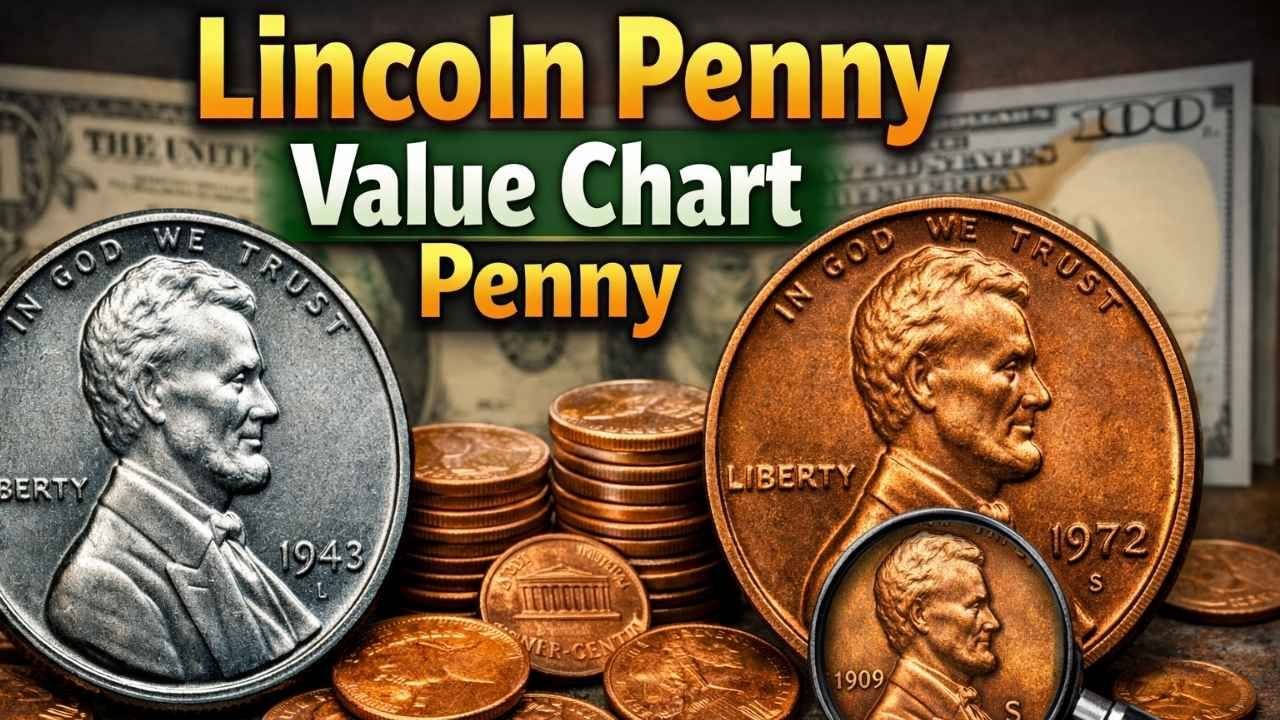
The Lincoln Penny is one of the most recognized coins in American history. First issued in 1909 to mark the 100th anniversary of Abraham Lincoln’s birth, it became the first U.S. coin to feature a real historical figure. Designed by Victor David Brenner, the original reverse showcased two wheat stalks—giving rise to the beloved “Wheat Penny” nickname.
More than a century later, Lincoln cents remain a cornerstone of coin collecting. While billions have been produced, certain years, mint marks, and error varieties are worth far more than one cent. For collectors and investors alike, understanding the Lincoln Penny value chart can reveal surprising opportunities.
Why Lincoln Pennies Continue to Attract Collectors
Lincoln cents combine accessibility with historical depth. They circulated through world wars, economic shifts, and design transitions, making them miniature records of American history.
Collectors are drawn to Lincoln Pennies for several reasons:
- Wide availability for beginners
- Rare key dates with significant upside
- Dramatic mint errors
- Strong auction performance
- Long-term collector demand
From entry-level hobbyists to advanced numismatists, Lincoln cents offer layers of complexity and value.
Key Factors That Determine Lincoln Penny Value
Not every old penny is rare. Value depends on specific characteristics that separate common coins from true collectibles.
Year of Issue
Certain years had limited production, making surviving examples scarce. Early 20th-century issues are particularly important.
Mint Mark
Lincoln cents were struck at Philadelphia (no mint mark until 1980), Denver (D), and San Francisco (S). Mint location can dramatically influence rarity.
Condition
Condition is critical. Coins are graded on a scale from Poor (P-1) to Mint State (MS-70). Higher-grade coins—especially those with original luster—command premium prices.
Errors and Varieties
Mint mistakes such as doubled dies, off-center strikes, or wrong-metal compositions can significantly increase value.
Lincoln Wheat Penny Value Chart: Key Dates
The Wheat Penny era (1909–1958) contains some of the most valuable Lincoln cents ever produced.
1909-S VDB
One of the most famous U.S. coins, the 1909-S VDB features the designer’s initials on the reverse. With only 484,000 minted, it is a key date in the series.
Even in circulated condition, examples can sell for thousands. High-grade specimens are significantly more valuable.
1914-D
The 1914-D is scarce due to low mintage and heavy circulation. Authentic examples in strong condition are highly sought after and frequently command four-figure prices.
1922 No D
In 1922, all Lincoln cents were struck in Denver. However, certain coins appear without the “D” mint mark due to die wear and production issues. These “No D” varieties are rare and valuable.
1931-S
With a mintage of only 866,000, the 1931-S is one of the lowest-production Wheat Pennies. Many were saved early, but high-grade examples remain desirable.
1943 Copper Penny
During World War II, pennies were struck in zinc-coated steel to conserve copper. A small number were mistakenly struck on leftover copper planchets.
The 1943 copper penny is one of the most famous error coins in U.S. history, with authenticated examples selling for hundreds of thousands—and in some cases over a million dollars.
1955 Doubled Die Obverse
This variety shows dramatic doubling on the date and lettering. The error is visible without magnification, making it one of the most recognizable doubled die coins.
Strong examples regularly sell for significant premiums.
Lincoln Memorial Penny (1959–2008)
In 1959, the reverse design changed to feature the Lincoln Memorial, commemorating the 150th anniversary of Lincoln’s birth. While most Memorial cents are common, certain dates and varieties stand out.
1969-S Doubled Die
A rare and dramatic doubled die variety. Authentic examples are scarce and valuable, particularly in higher grades.
1972 Doubled Die
Another popular doubled die variety, showing clear doubling in the obverse lettering.
1983 Doubled Die Reverse
This variety features doubling on the reverse lettering and design elements. Well-preserved examples are collectible.
1992 Close AM
In 1992, a small number of circulation coins were struck with a reverse design intended for proof coins, showing the letters “A” and “M” in “AMERICA” nearly touching.
This subtle variety is highly prized once identified.
Bicentennial and Shield Reverse Cents
In 2009, four special reverse designs were issued to commemorate Lincoln’s bicentennial, highlighting stages of his life. While most remain common, certain proof and high-grade examples are collectible.
In 2010, the reverse changed again to a Union shield design. Modern Lincoln Shield cents are generally abundant, though transitional errors and top-population graded coins can carry premiums.
The Importance of Professional Grading
Authentication and grading are essential for high-value Lincoln cents. Professional grading services evaluate:
- Surface preservation
- Strike quality
- Luster
- Eye appeal
A rare coin in MS65 condition may be worth multiples of the same coin in AU (About Uncirculated) condition. For major key dates, certification provides both credibility and market liquidity.
Auction Records and Market Trends
Lincoln cents have produced some of the most remarkable auction results in U.S. coin collecting. The 1943 copper penny and 1909-S VDB remain headline makers.
Market trends show continued strength for:
- Key date Wheat Pennies
- Dramatic doubled dies
- Top-population graded examples
- Historically significant error coins
As tangible assets gain attention among alternative investors, rare Lincoln cents remain an accessible yet prestigious segment of the numismatic market.
Building a Strategic Lincoln Penny Collection
For beginners, assembling a Wheat Penny date-and-mint set is a rewarding goal. Many common dates are affordable and widely available.
Advanced collectors often focus on:
- Certified key dates
- Error and variety coins
- High-grade registry-quality examples
- Low-mintage transitional issues
A disciplined approach—prioritizing quality over quantity—can significantly enhance long-term value.
Preservation Best Practices
Maintaining condition is critical. To protect your Lincoln pennies:
- Store in archival-quality holders or certified slabs
- Avoid direct handling
- Keep coins in a stable, low-humidity environment
- Never clean or polish the surface
Cleaning may permanently damage a coin and reduce its value.
Cultural and Historical Significance
Beyond monetary value, the Lincoln Penny reflects more than a century of American history. It has survived global conflicts, economic transitions, and design evolution—while remaining a daily symbol of Lincoln’s enduring legacy.
For many collectors, the appeal extends beyond investment. Each coin tells a story, linking generations through tangible history.
Final Thoughts
The Lincoln Penny value chart is more than a price guide—it is a roadmap to one of the most dynamic segments of American coin collecting. From the legendary 1909-S VDB to the rare 1943 copper cent, these small coins can carry extraordinary value.
Whether you are examining spare change or building a curated collection, understanding key dates, mint marks, and grading standards can unlock hidden opportunities. In the world of numismatics, even a single penny can become a remarkable asset.