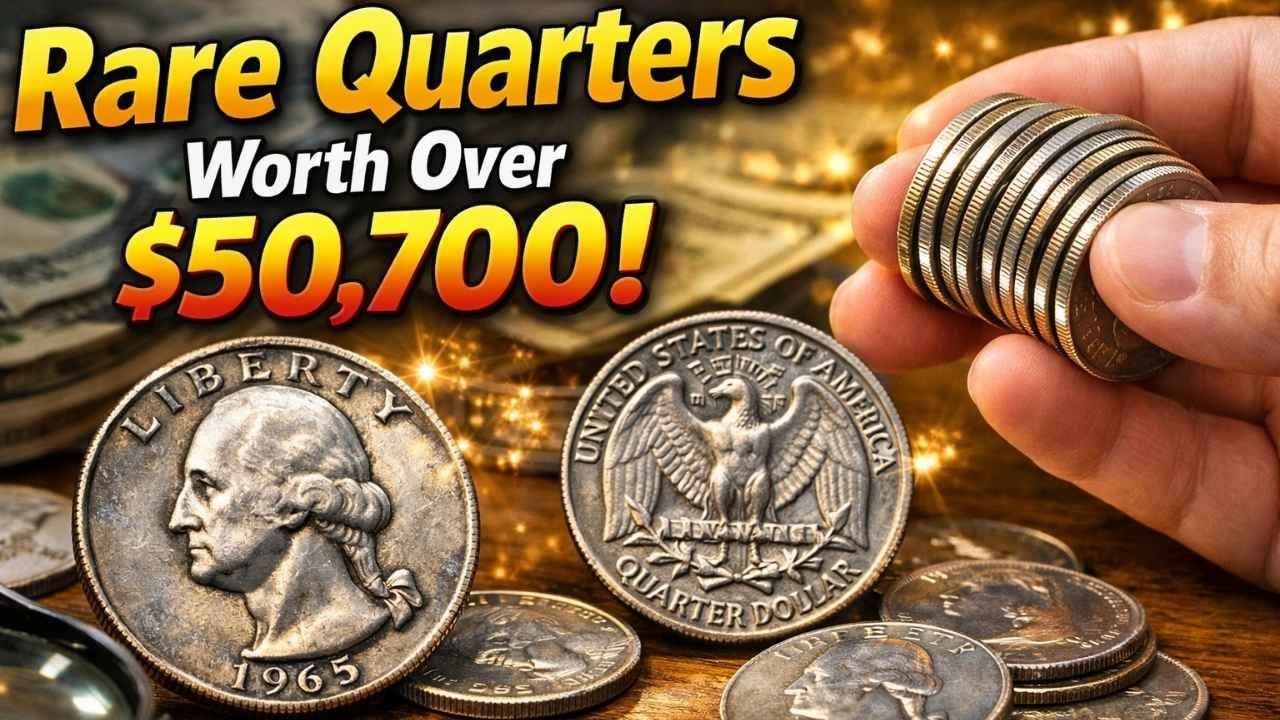
Quarters are one of the most recognizable coins in American currency. They pass through millions of hands every day, used for everything from parking meters to everyday purchases. Yet within this ordinary denomination lies a world of extraordinary value. Certain rare quarters have sold for more than $50,700 at auction, transforming simple pocket change into serious financial assets.
For collectors and investors alike, rare quarters represent history, scarcity, and opportunity. Understanding which coins carry premium value—and why—can turn an overlooked collection into a portfolio-worthy holding.
Why Some Quarters Are Worth a Fortune
The vast majority of quarters are worth exactly 25 cents. However, a small percentage achieve significant premiums due to four key factors:
- Low original mintage
- Minting errors or unusual varieties
- Exceptional condition
- Strong collector demand
When rarity and preservation intersect, values can climb rapidly—especially in competitive auction environments.
Below are 14 quarters that have captured attention for their scarcity and market performance.
1. 1932-D Washington Quarter
The Washington Quarter debuted in 1932 to commemorate George Washington’s 200th birthday. The Denver Mint produced only 436,800 coins that year, making the 1932-D one of the lowest-mintage quarters in the series.
High-grade examples, particularly those graded Mint State, have reached five-figure prices at auction.
2. 1932-S Washington Quarter
The San Francisco Mint struck just 408,000 quarters in 1932. Like its Denver counterpart, the 1932-S is a cornerstone coin for Washington Quarter collectors.
Well-preserved specimens remain highly sought after and frequently command strong premiums.
3. 1943-S Silver Washington Quarter
Struck during World War II, the 1943-S quarter is part of the 90% silver era. While silver quarters are common overall, certain high-grade San Francisco issues are rare.
Top-condition coins with original luster can achieve impressive auction results.
4. 1950-D/S Overmintmark Quarter
An overmintmark occurs when one mint mark is stamped over another. The 1950-D/S variety shows a Denver “D” struck over a San Francisco “S.”
Collectors value these visible minting anomalies, especially when authenticated and graded.
5. 1964-D Doubled Die Obverse Quarter
Doubled die errors result from misalignment during die creation. On the 1964-D variety, doubling is visible in the date and lettering.
Clear, dramatic examples in uncirculated condition have reached substantial values.
6. 1970-S Proof Quarter Struck on Canadian Planchet
One of the most fascinating mint errors, this proof quarter was struck on a silver Canadian coin blank. The result is a hybrid coin with distinct weight and metal differences.
Such dramatic errors are extremely rare and can surpass $50,000 depending on condition and certification.
7. 1976 Bicentennial Quarter (High-Value Errors)
The Bicentennial Quarter, featuring a colonial drummer reverse, was minted in large numbers. However, certain error varieties—such as doubled dies or major off-center strikes—are scarce.
Certified error examples in pristine condition have achieved notable auction prices.
8. 1982 No Mint Mark Quarter
In 1982, mint marks were standard for circulation coins. A small number of quarters were struck without the expected mint mark, creating a rare variety.
Uncirculated examples are especially desirable among collectors.
9. 1983 Doubled Die Reverse Quarter
This variety features visible doubling on reverse lettering and design elements. Because 1983 mint sets were not officially produced, high-grade examples are more difficult to locate.
Premium-condition coins often sell for significant amounts.
10. 1999-P Connecticut Broadstrike Error
State quarters launched in 1999, igniting renewed public interest in coin collecting. Some Connecticut quarters were struck without the retaining collar, creating a broad, distorted shape.
Well-preserved broadstrike errors have drawn strong bidding in specialized auctions.
11. 2004-D Wisconsin Extra Leaf Quarter
Perhaps the most famous state quarter error, this coin features an additional leaf on the ear of corn—either a “high leaf” or “low leaf” variety.
High-grade certified examples have sold for thousands, with select specimens achieving remarkable results.
12. 2005 Minnesota Doubled Die Quarter
The Minnesota state quarter produced numerous doubled die varieties, particularly visible among the trees on the reverse design.
Certain rare die pairings are far more valuable than others, rewarding careful examination.
13. 2009 District of Columbia Doubled Die Reverse
Part of the District of Columbia and U.S. Territories series, some 2009 quarters exhibit noticeable reverse doubling. Although modern, rare high-grade examples are already gaining traction.
14. Washington Quarter Mule Error (Quarter/Dollar Hybrid)
One of the most famous modern U.S. mint errors combines a Washington quarter obverse with a Sacagawea dollar reverse. Though technically not a standard quarter issue, it is closely tied to the series.
These mule errors are extraordinarily rare and have sold for tens of thousands of dollars.
The Critical Role of Condition and Grading
Condition dramatically influences value. A rare quarter in circulated condition may sell for hundreds, while the same coin in Mint State 67 or higher can be worth exponentially more.
Professional grading services assess:
- Surface quality
- Strike sharpness
- Luster
- Eye appeal
Coins certified at top-population grades often achieve record-setting results due to their scarcity within the grading scale.
Auction Trends and Market Strength
Rare quarters continue to perform well in global auctions. As tangible assets gain favor among investors seeking diversification, numismatic rarities attract renewed interest.
Key drivers include:
- Increased digital auction accessibility
- International collector participation
- Rising appreciation for modern error coins
- Strong historical appeal
The market rewards rarity, authentication, and impeccable preservation.
Building a High-Value Quarter Collection
For newcomers, quarter collecting offers a practical entry point. Circulation finds can still yield surprises, particularly among state quarters and modern issues.
Advanced collectors often pursue:
- Complete year-and-mint sets
- Certified high-grade examples
- Recognized error varieties
- Key low-mintage coins
Strategic collecting—focused on scarcity and quality—can elevate a simple hobby into a meaningful investment.
Preservation Best Practices
To protect long-term value:
- Store coins in archival holders or certified slabs
- Avoid direct handling
- Maintain a stable, low-humidity environment
- Never clean or polish coins
Cleaning can permanently damage surfaces and reduce market value.
Final Thoughts
Quarters may appear ordinary, but hidden within this everyday denomination are coins capable of exceeding $50,700 in value. From low-mintage 1932 issues to dramatic modern mint errors, rare quarters prove that history and scarcity can transform simple change into remarkable assets.
For collectors and investors alike, the opportunity lies in careful observation, informed research, and disciplined preservation. Sometimes, the next great discovery is already sitting quietly in a drawer—or waiting in your pocket.