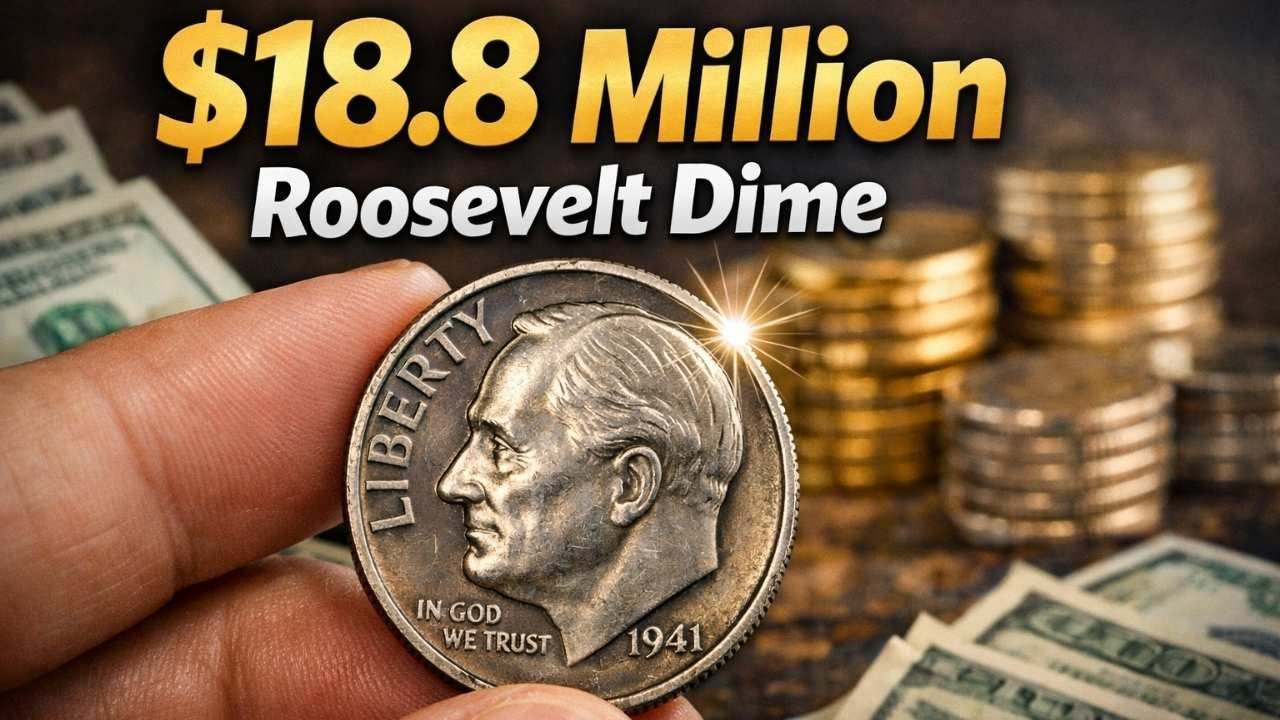
The Roosevelt Dime has been part of American currency since 1946, introduced shortly after President Franklin D. Roosevelt’s passing. Chosen to honor his leadership during the Great Depression and World War II—as well as his connection to the March of Dimes—the coin carries both historical and emotional weight.
At first glance, it is a small silver-colored coin used in everyday transactions. Yet in the world of elite numismatics, certain Roosevelt Dimes have reached astonishing valuations. The story of a dime reportedly valued at $18.8 million captures the imagination of collectors and investors alike, highlighting how rarity and perfection can elevate a ten-cent coin into a multimillion-dollar asset.
Why Some Roosevelt Dimes Command Extraordinary Prices
Most Roosevelt Dimes in circulation are worth face value. However, a select few become exceptional due to a powerful combination of rarity, condition, and collector demand.
Key Value Drivers
Several factors determine whether a Roosevelt Dime is ordinary—or extraordinary:
- Extremely low surviving population
- Significant mint errors
- Missing mint marks
- High-grade preservation (Mint State or Proof 70)
- Strong auction demand
When these elements align, prices can rise dramatically. In rare cases, competitive bidding between high-net-worth collectors can push valuations into record-breaking territory.
The Legend of the $18.8 Million Roosevelt Dime
The dime associated with the $18.8 million valuation became a symbol of modern numismatic fascination. While most Roosevelt Dimes were produced in large quantities, this particular coin stood apart due to its unique characteristics and near-perfect preservation.
Coins that achieve this level of value typically combine three qualities:
- Extreme rarity
- Flawless or near-flawless grading
- Historical or production significance
In high-end collecting circles, coins that meet these standards are viewed not simply as currency but as portable works of art with tangible scarcity.
Mint Errors That Transform Dimes into Treasures
Mint errors are often the catalyst behind headline-making coin values. Even minor production mistakes can dramatically increase desirability—especially when discovered in pristine condition.
Common High-Value Error Types
Doubled Die Errors
These occur when the coin die receives a misaligned impression during manufacturing. The result is visible doubling in letters or numbers.
Missing Mint Marks
Certain proof and circulation dimes were mistakenly struck without their intended mint mark. These are among the most sought-after Roosevelt Dime varieties.
Off-Center Strikes
When a coin is not properly aligned during striking, part of the design may be missing. Dramatic off-center examples attract strong premiums.
Wrong Planchet Errors
Occasionally, a dime is struck on a blank intended for another denomination. These dramatic anomalies are rare and highly collectible.
Key Rare Roosevelt Dimes to Know
While multimillion-dollar examples are exceptionally rare, several Roosevelt Dimes consistently command strong premiums.
1968 No S Proof Dime
One of the most famous modern proof errors, this coin was struck in San Francisco but lacks the “S” mint mark. Only a few examples are known, making it highly valuable in certified condition.
1970 No S Proof Dime
Similar to the 1968 variety, this proof coin is missing its mint mark. It remains a prized discovery among advanced collectors.
1982 No P Dime
This circulation strike from Philadelphia was accidentally produced without the “P” mint mark. Unlike most proof-only errors, this variety was found in everyday change, adding to its intrigue.
1996-W Roosevelt Dime
Issued to mark the 50th anniversary of the series, this West Point Mint coin was included in special collector sets. Its limited mintage gives it enduring appeal.
1949-D Roosevelt Dime
Scarce in high Mint State grades, this early issue attracts registry-set collectors seeking top-tier examples.
The Power of Condition and Professional Grading
In modern coin markets, grading is everything. A Roosevelt Dime graded MS67 or higher can be worth exponentially more than the same coin in circulated condition.
Professional grading services evaluate:
- Surface preservation
- Luster and brilliance
- Strike sharpness
- Overall eye appeal
Coins that achieve top-population grades—meaning few or none are graded higher—often command the strongest auction results. In ultra-competitive markets, a single grade point difference can represent thousands or even millions of dollars.
Auction Records and Market Momentum
Rare Roosevelt Dimes have consistently demonstrated strong performance at auction. As alternative investments gain traction among sophisticated buyers, tangible assets such as rare coins are increasingly viewed as portfolio diversifiers.
High-profile sales create a ripple effect:
- Increased media attention
- Growing collector interest
- Rising demand for certified examples
- Greater global participation in bidding
The result is a resilient and often appreciating niche market.
How to Spot a Potentially Valuable Roosevelt Dime
While multimillion-dollar finds are extraordinarily rare, valuable dimes can still be discovered in collections—or occasionally in circulation.
What to Look For
- Examine the mint mark carefully. Missing letters can signal rare varieties.
- Use magnification to check for doubling in text or dates.
- Inspect for unusual strike alignment.
- Look for sharp detail and minimal wear.
- Compare weight and metal composition if something seems unusual.
If you believe you have a rare example, professional authentication is essential before making any assumptions about value.
Preservation: Protecting Long-Term Value
Rare coins require careful handling. Even minor scratches or environmental exposure can significantly reduce value.
Best practices include:
- Storing coins in certified holders or archival-quality capsules
- Avoiding direct contact with bare hands
- Keeping coins in stable, low-humidity environments
- Never cleaning or polishing the surface
Cleaning, in particular, can permanently damage a coin’s surface and drastically lower its market price.
Cultural and Historical Significance
Beyond financial considerations, the Roosevelt Dime carries deep historical meaning. It commemorates a president whose leadership shaped modern America and whose advocacy helped fund medical breakthroughs through the March of Dimes.
Collectors often view the coin as more than metal—it represents resilience, leadership, and mid-20th-century American history.
The Psychology Behind Multimillion-Dollar Coins
Why would someone pay millions for a dime?
Elite collectors are often motivated by:
- Ownership of a one-of-a-kind asset
- Competitive registry rankings
- Long-term wealth preservation
- Passion for historical artifacts
In high-net-worth circles, rarity and exclusivity can outweigh face value many times over.
Final Thoughts
The $18.8 million Roosevelt Dime stands as a powerful reminder that extraordinary value can hide in ordinary places. While most dimes remain worth ten cents, rare varieties demonstrate how scarcity, condition, and demand can transform small change into substantial wealth.
For collectors, the Roosevelt Dime represents both history and opportunity. Whether you are a seasoned numismatist or a curious investor exploring alternative assets, understanding what makes certain coins exceptional is the first step toward discovering hidden value in the smallest denominations.